Project description
BAT-SAFE is an FFG-funded research project in which the chair AVAW is working on the risks and impacts of batteries in waste management systems. The project is done in cooperation with Eco World Styria Umwelttechnik Cluster GmbH, der Elektro Recycling Austria GmbH und der Saubermacher Dienstleistungs AG. In contrast to former battery-related research projects, BAT-SAFE is dealing with portable batteries, especially lithium-batteries.
Background and problem
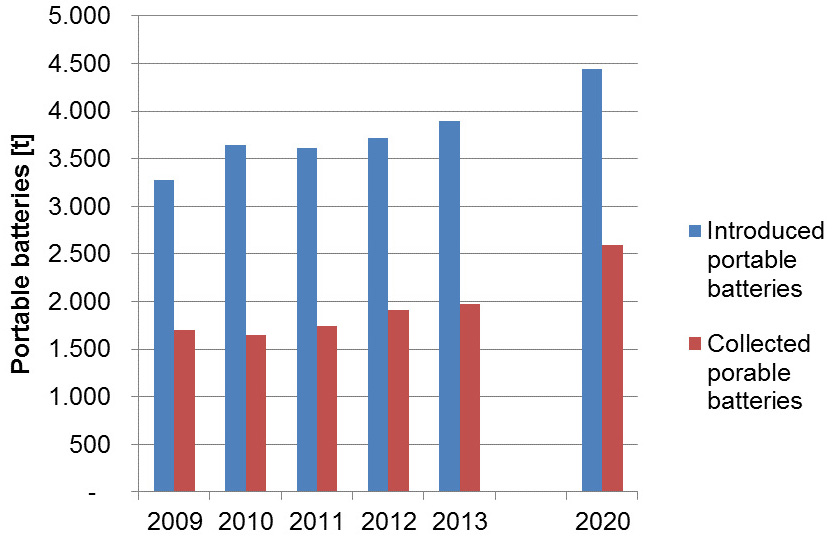
On the one hand, increasing amounts of battery-powered devices and appliances and, on the other hand, the increased use of lithium-based high-energy batteries was observed in the last decade (see picture 1 and 2).
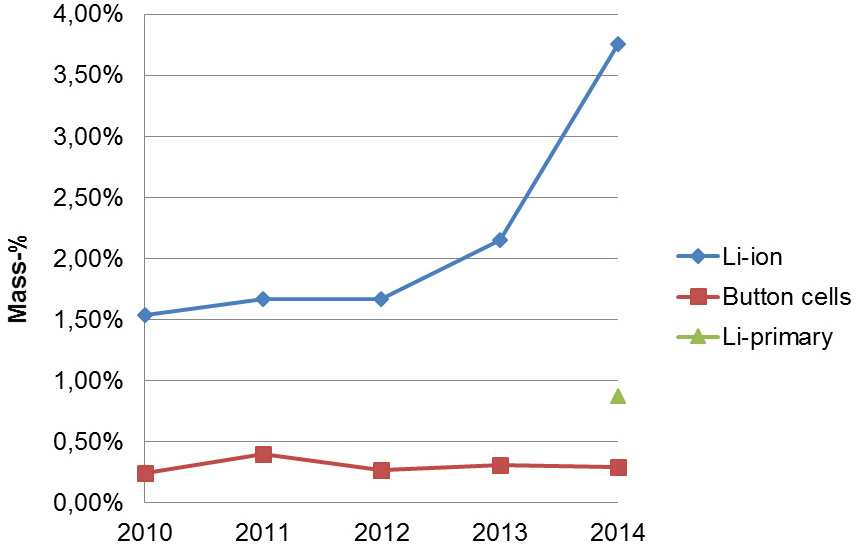
Relative share of lithium-batteries (LIB) in unsorted waste battery collection // Source: Arnberger & Pomberger, 2015
Against this background, the amount of events of fire which are causally related to batteries are increasing. Due to rising amounts in future development, the risk potential for events of fire will further increase in the entire end-of-life phase (including waste collection, (temporary) storage and transport, waste treatment and further processing).
BAT-SAFE
In order to identify the status quo of Austrian waste management systems and battery-relevant waste streams, sorting analyses and material flow analysis are used. Furthermore, a comprehensive causal investigation of previous events of fire is conducted. Crucial waste fractions, treatment plants and treatment processes are identified. Additionally, the behaviour of batteries in events of fire are investigated by field experiments and simulation. Finally, a scientifically sound risk assessment will be done, in order to deduce appropriate measures and approaches to meet the imminent challenges in Austrian waste management.
Aims of the project
- Analysis of previous events of fire (causal investigation),
- Identification of battery-relevant waste streams (material flow analysis),
- Study of battery behaviour in events of fire (field experiments and simulation) and
- Development of a scientifically sound risk assessment of batteries in Austrian waste management systems
Publications
- Nigl T. & Pomberger R. (2018): Brandgefährliche Abfälle - Über Risiken und Strategien in der Abfallwirtschaft. Konferenzbeitrag zur Recy & DepoTech 2018. 7.-9. November 2018, Montanuniversität Leoben.
- Nigl T., Schwarz T., Hohenberger M. (2018): Die Vielfalt der Batterien. Poster zum Partnertag der Abfallwirtschaft. Leoben, 19.06.2018.
- Nigl T., Schwarz T., Hohenberger M. (2018): Akkus von Elektronikgeräten sind immer seltener entnehmbar. Poster zum Partnertag der Abfallwirtschaft. Leoben, 19.06.2018.
- Nigl T., Schwarz T., Hohenberger M. (2018): Gefahren durch Batterien im Haushalt. Poster zum Partnertag der Abfallwirtschaft. Leoben, 19.06.2018.
- Nigl T., Schwarz T., Hohenberger M. (2018): Sammlung und Recycling von Batterien. Poster zum Partnertag der Abfallwirtschaft. Leoben, 19.06.2018.
- Nigl T. (2018): Batterieentsorgung in Österreich – neue Pflichten bei der Abfallbehandlung und Studienergebnis zu alternativem Behältermanagement. Fachkonferenz Lithiumbatterien. Frankfurt, 15.-16.01.2018.
- Nigl T., Schwarz T. (2017): Lithium-Ion-Batteries -Recycling and Safety Aspects in Waste Management Systems. First Scientific Exchange in Waste Technology and Environmental Engineering. Leoben, November 9th-10th 2017.
- Nigl T., Schwarz T., Arnberger A. (2017): Waste Li-Batteries – A Struggle to Safety in Waste Management Systems? International Congress of Battery Recycling. Lisbon, Portugal, September 20th-22nd 2017.
- Nigl T. (2017): Der Anteil von Gerätebatterien und Lithium-batterien im Restmüll – eine Analyse. ÖWAV-Tagung "Österreichische Abfallwirtschaftstagung 2017 – Die Digitalisierung der Abfallwirtschaft", Graz, 10.-11.05.2017. ISBN: 978-3-903149-20-5.
- Nigl T. (2016): "Zwischenlagerung, Aufbereitung und Verwertung von Lithium-Ionen-Batterien und -Akkumulatoren". ÖWAV-Seminar "Der Umgang mit High-Tech-Produkten in der Abfallwirtschaft", Wien, 13.09.2016. ISBN: 978-3-902978-98-1.
- Nigl T. & Pomberger R. (2016): Stand, Entwicklungen und Problematik von Lithium-Batterien. VÖEB-Tagung "Lithium-Batterien - Eine Herausforderung für die Recyclingwirtschaft", Schwechat, 29.09.2016.