Working group "Methodes and Environmental Analytical Chemistry"
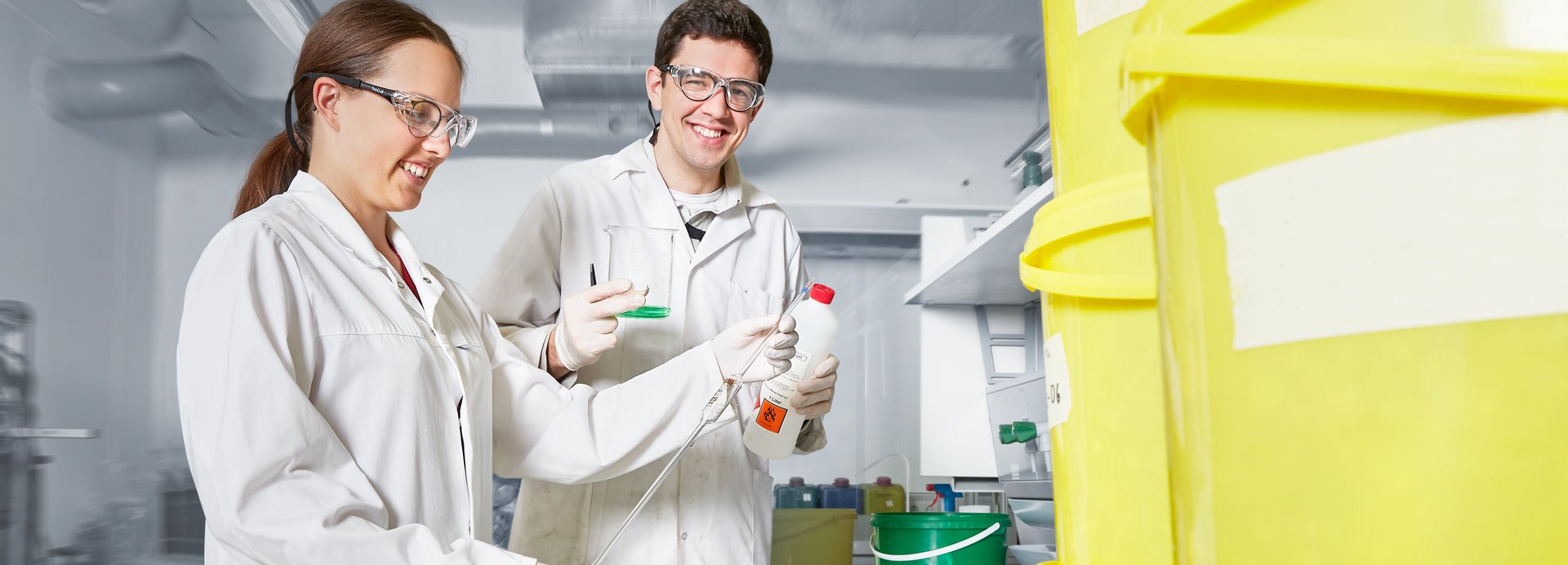
The focus of the working group “Methods and Environmental Analytical Chemistry” is on issues and challenges in the areas of sensor-based sorting and environmental analysis. Particular emphasis is placed on the development and validation of sensor-based and chemical methods for a wide variety of waste. On the other hand, the focus is on the practical implementation of these methods, taking into account a networked and holistic view of recycling processes. Due to the ongoing projects, the focus is currently on the following waste streams in particular: metals, plastics, textiles and biogenic waste.
| Project long title | Project short title | Project start |
| Packaging and process optimization of plastic packaging with sleeves | Sleeve | 2025 |
| Sorting and processing strategies for used textiles for the production of recyclable fractions | StraTex | 2024 |
| Mechanical recycling of plastics: From waste plastics to high-quality, specification-compliant recyclates | circPlast-mr | 2022 |
| Module 2 in the CD Laboratory for Design and Evaluation of an Efficient, Recycling-Based Circular Economy | CD-Labor | 2021 |
| Project long title | Project short title | Project period |
| Implementation of a quality-optimized cycle for PO films from the increased quantity light fraction collection | Flex4Loop | 2022-2025 |
| Development and testing of a sensor-based material flow monitoring system | EsKorte | 2020-2024 |
| Circular plastics network for training | C-PlaNeT | 2020-2024 |
| Identification of multilayer films in plastic sorting to increase the recycling of packaging film waste | MultiLayer Detection | 2021-2023 |
| Basics for the automatic detection and the sensor-based sorting of plastics in biogenic materials | DeSort | 2018-2021 |
Equipment
The chair AVAW has extensive analysis equipment for raw material and sample analysis and has a compact sensor-supported test stand available for application and contract research projects, which is designed as a two-way machine with a pneumatic separating device. A particle size range from 3 to 200 mm can be processed. The test stand is equipped with three industrial sensors (NIR spectral imaging sensor, high-resolution RBG line sensor with incident/transmitted light mode and induction sensor). This enables the sorting of a wide range of secondary raw materials, such as waste glass, paper and cardboard, plastic flakes, lightweight packaging, electronic waste, construction waste, compost and waste wood. By means of sensor fusion, the test system offers the possibility of flexibly combining several sensors with each other in order to solve even very complex or new research tasks. In addition, a large-scale test facility with an integrated belt sorter is available in the chair's own “Digital Waste Research Lab” in St. Michael. This is equipped with advanced multi-sensor technology and can be operated in combination with other processing units. In particular, it enables cycle simulation and material flow analyses in connection with research focuses in the field of process digitization.
We have summarized the equipment available at the AVAW chair on a separate page.