Project description
How much emissions are released through the collection and treatment of waste? What is the environmental impact of recycling 1 ton of scrap metal? What about the same amount of primary metal? How can the benefits of separate collection be quantified?
The climate balance tool, which was developed on behalf of the Province of Styria – Department 14 and Department 15, aims to answer these questions in a clear and understandable way. The aim of the climate balance tool project is to present the greenhouse gas emissions from waste management activities in the municipal area of the Province of Styria. To this end, the AVAW Chair, with the support of the University of Applied Sciences Technikum Wien, has created a carbon footprint calculator. This is intended to enable stakeholders to generate emissions from collection, treatment, and landfill as quickly as possible and without prior knowledge, and to communicate these to interested parties with the help of design elements.
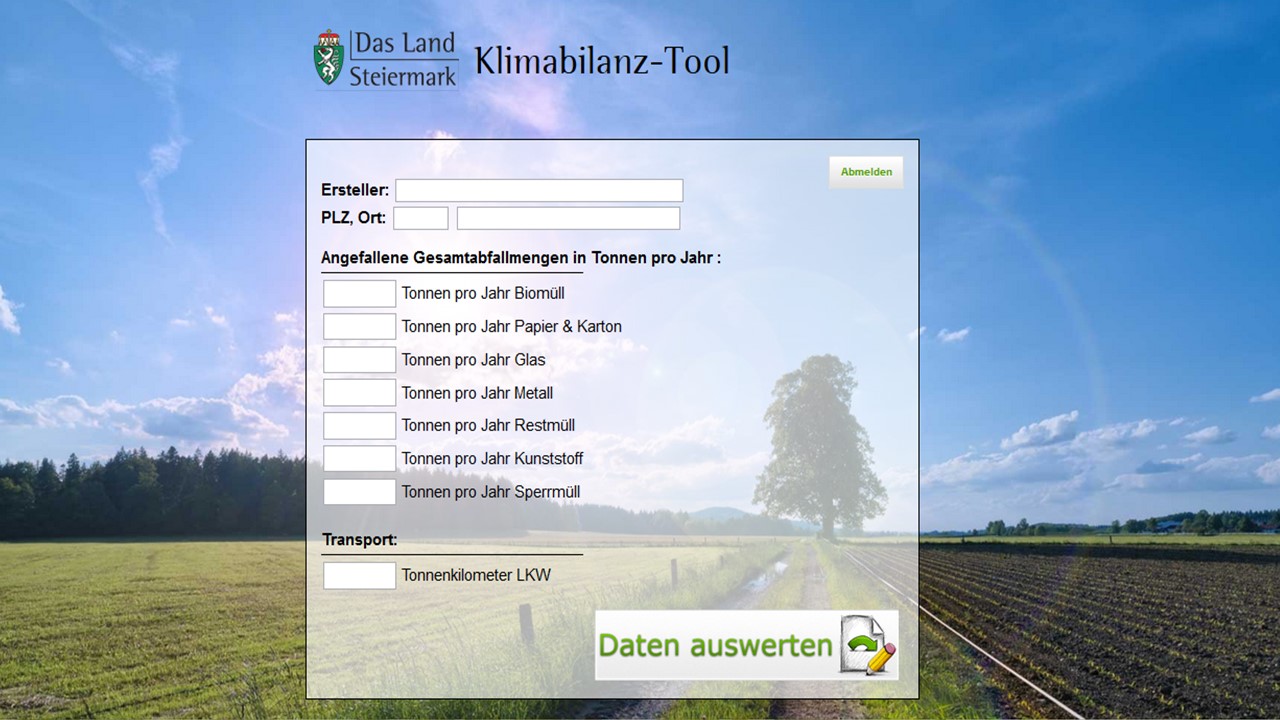
In order to compare different waste streams, processes, and years, the functional unit and system boundaries were introduced. The functional unit is “1 ton of waste.” Geographically, the study is limited to municipal waste streams in Styria and Styrian facilities/municipalities, etc. The calculation is based on a system boundary of one year, with 2010 selected as the reference year for the data.
The study/tool only takes into account waste quantities collected by municipalities. The waste categories were formed by combining several subcategories and cut off with a mass criterion of 1%. The following 7 waste categories are to be evaluated:
Biowaste, paper, glass, metal, residual waste, plastic, and bulky waste.
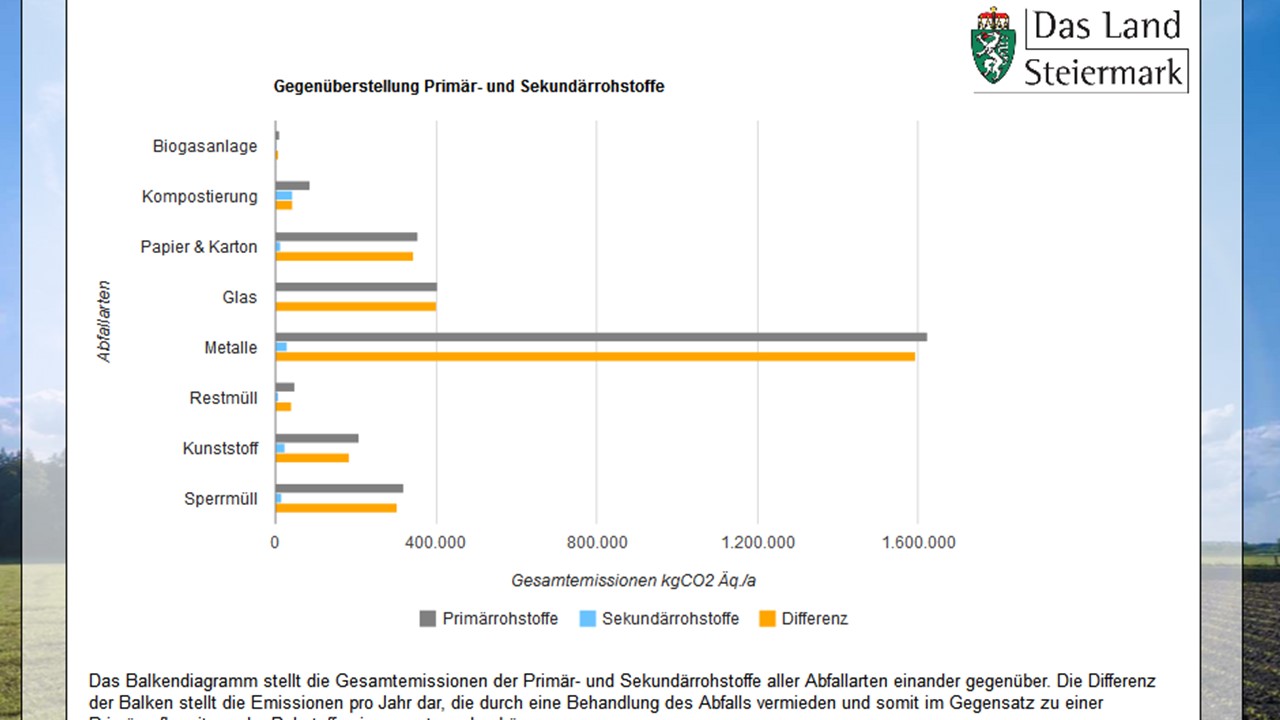
Presentation of emissions from primary and secondary processing and the difference between them (only in German language) // Fotocredit: MUL/AVAW
Methodologically, the greenhouse gas balance was modeled as a life cycle analysis, with the results expressed in kg CO2 equivalents per year. In order to weight the individual emission values, the three gases relevant to waste management—CO2, CH4, and N2O—were aggregated into CO2 equivalents. Credits generated from electricity production, heat generation, and the creation of secondary products are also expressed in CO2 equivalents and compared with emissions from waste management. In addition to emissions from the processing of waste volumes, transport emissions were also taken into account in the calculation.
The communication tool is available at the following addresses:
klima.unileoben.ac.at or www.klimabilanz.steiermark.at.
The climate balance tool is currently available free of charge and is specifically designed for Styrian stakeholders in waste management. However, it would be possible to adapt it for other regions and with a different focus. We look forward to receiving your inquiries!
You can obtain the password on request from:
State of Styria – A14 Water Management, Resources, and Sustainability (Land Steiermark – A14 Wasserwirtschaft, Ressourcen und Nachhaltigkeit)
Waste Management and Sustainability Unit (Referat Abfallwirtschaft und Nachhaltigkeit)
Bürgergasse 5a, 8010 Graz
Mister Günter Felsberger
Phone: +43 316 / 877-4149
Email: guenter.felsberger(at)stmk.gv.at
Aims of the project
The aims of the procejt include:
- Development of a carbon footprint tool for waste management,
- Presentation of emissions generated from municipal waste management in Styria,
- Presentation of emission reduction potential by using secondary materials instead of raw materials,
- Intuitive communication and motivation tool for Styria stakeholders,
- General applicable tool for political and technical decision makers at a local, regional scale as well as on plant level,
- Export function of results included.