Project description
To make the packaging industry more circular, products must be rethought. The "SLEEVE" project builds on this and addresses the topic of sleeved packaging. Sleeves are a type of packaging labeling in which up to 100% of the main body is concealed and usually no adhesive is used. Sleeves can offer added value in many ways: They can be used as large-format information carriers, increase product recognition, contribute to product protection, and under certain conditions lead to improved circularity. However, this circularity must be better implemented. The consortium believes that sleeves, if correctly separated and detectable, contribute to improved quality, as contaminants (such as printing inks) can be optimally removed from the material stream and thus eliminated.
Aims of the project
The project aims to evaluate advantageous material combinations for sleeves from specific product categories (use cases) (packaging design) and to survey consumer behavior in order to separability (sleeve separation behaviour), improve detection (sortability), and recyclates’ quality (recycling).
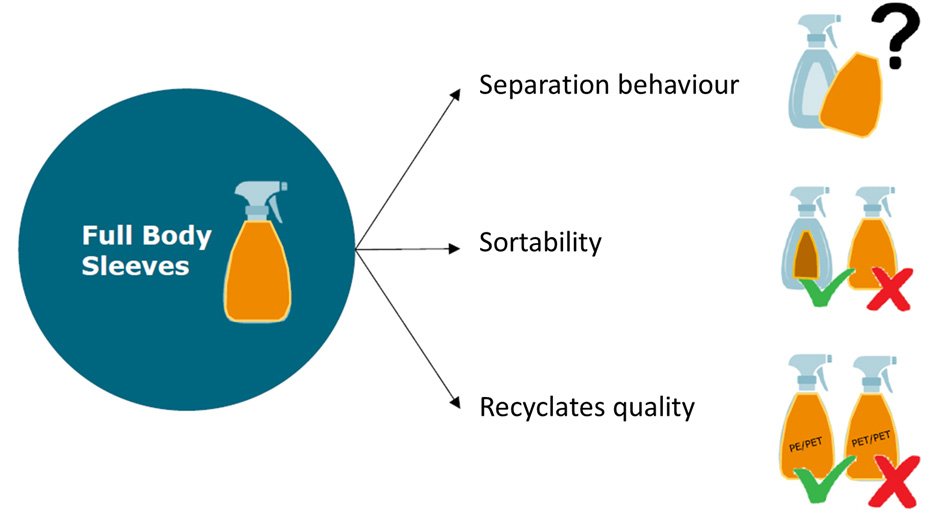
In addition to the collection and characterization of material combinations for selected product categories, the packaging design process will also include an evaluation of existing communication elements for separating sleeves and a comprehensive sustainability assessment. Regarding consumer behavior, a survey and a representative sorting analysis will compare actual separation behavior with respondents' assessments. This will also allow the current potential of the Austrian lightweight packaging collection system to be assessed.
At AVAW, the key tasks will include experimentally assessing sortability using sensor-assisted technology and developing optimal material combinations for the recyclability of selected product categories. The sorting tests using sensor-assisted technology are intended to determine which material combinations (body – sleeve) can be best detected. Material combinations that are already used on the market by the participating companies are being tested. Since there are currently many different combinations of body – sleeve on the market, recycling is being tested in addition to assessing the material combinations. The effect of sleeve color on sorting and recycling is also being considered. The goal is to provide recommendations on the design for recycling of the sleeved products, based on the results of the sortability analysis – correlation between the colour, thickness, and polymer type combinations (body/sleeve).
Studied Products
The SLEEVE project focuses on representative product categories in the standard product range with a high turnover rate.
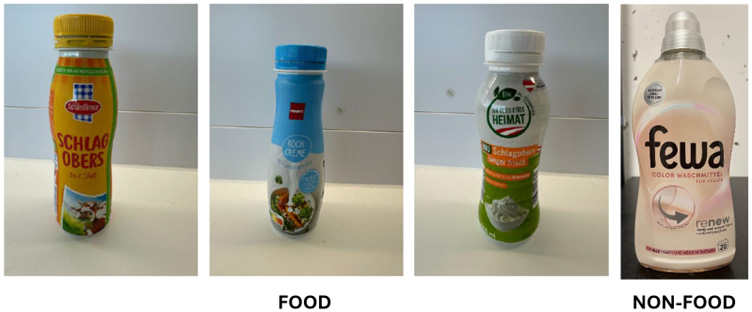
- Food (Dairy): Drinks, whipped cream and alternatives, butter, cheese, coffee drinks, dessert, yoghurt, refreshments, mascarpone (all brands except for NÖM).
- Non-food: Fabric softeners, detergents - washing liquids, other detergents, multi-purpose cleaners.