Scientific Highlights
This page presents outstanding research findings, significant publications and key scientific contributions from the project.
04/15/2026
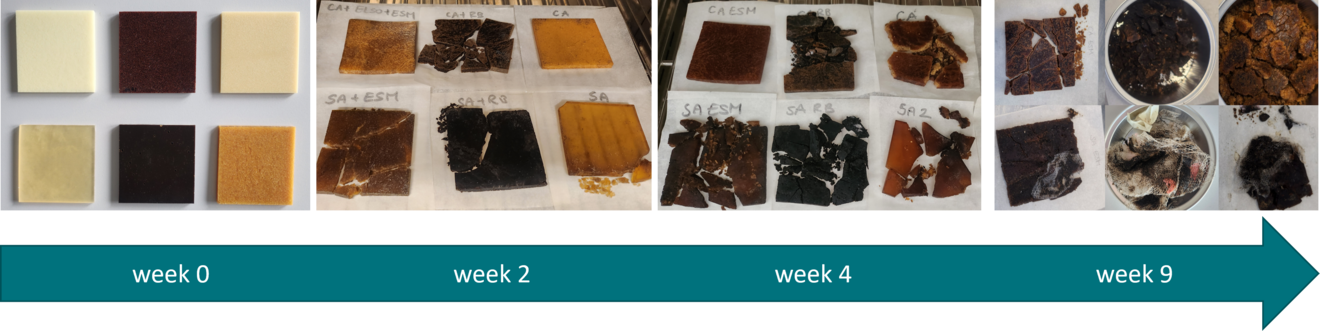
This study investigates the biodegradability of bio-based thermosets and the influence of bio-based fillers on degradation behavior. Epoxidized linseed oil was employed as the resin, cured with either citric acid (CA) or sebacic acid (SA), chosen for their well-characterized properties and differing glass transition temperatures (Tg ≈ 80°C for CA, 0°C for SA). Natural waste-derived fillers were incorporated, including eggshell membrane and red beet, selected for their availability, color, and potential catalytic effects on degradation pathways.
Biodegradability was assessed under realistic industrial composting conditions at Poschacher Kompost GmbH over a 12-week period. Samples were periodically retrieved to monitor temporal changes in material structure, mass, and surface morphology. The results revealed distinct degradation behaviors depending on the formulation, indicating the presence of multiple degradation mechanisms. Detailed analyses using DSC, FTIR, gravimetric, and microscopic techniques provided mechanistic insights into the chemical and physical processes underlying biodegradation.
Despite the variation in degradation rates and mechanisms, all formulations demonstrated complete biodegradability within the experimental timeframe. Notably, formulations with different Tg and filler composition exhibited accelerated or delayed breakdown, highlighting the role of both polymer network rigidity and filler chemistry in modulating biodegradation kinetics. The study underscores the potential of combining renewable resin systems with functional natural fillers to produce thermosets that are not only high-performing but also fully compostable, supporting circular material strategies.
These findings provide a strong scientific foundation for the development of sustainable bio-based thermosets with tunable degradation profiles, demonstrating that performance and environmental responsibility can be synergistically achieved.
Although further successful outcomes have been achieved—such as the high-yield, one-step synthesis of multifunctional bio-based epoxy monomers and curing agents without the need for solvents or purification (see above)—these results cannot currently be disclosed on the website, as the possibility of patent protection is under evaluation.
03/31/2026
Epoxy resins are indispensable materials in advanced composites, coatings, and structural adhesives due to their outstanding mechanical strength, chemical resistance, and thermal stability. However, the widespread reliance on bisphenol A (BPA)-based systems has raised increasing environmental and toxicological concerns. Addressing this challenge, the present work successfully demonstrates a green-by-design strategy for the development of high-performance, bio-based epoxy resins derived from renewable and environmentally benign precursors.
A central achievement of this study is the identification of aromatic bio-based building blocks capable of delivering thermomechanical properties comparable to conventional BPA-based systems. Owing to their rigid molecular architecture, these renewable precursors enable elevated glass transition temperatures while maintaining the sustainability profile of the material. To accelerate discovery and reduce experimental iteration cycles, a data-driven workflow was established. Machine learning models, trained on a curated dataset of experimentally reported epoxy systems, were employed to predict glass transition temperature directly from molecular structure. Random Forest Regression successfully identified key structural motifs governing thermal performance.
The initial model predictions revealed that epoxy systems incorporating anhydride-containing and phenolic moieties can achieve Tg values of 137 °C and 133.53 °C, respectively, when cured with anhydride-based hardeners. These findings confirm the feasibility of reaching high thermal performance without relying on BPA-derived chemistries. Although the current dataset primarily emphasizes Tg, ongoing efforts focus on dataset expansion and the implementation of Gaussian process models to enhance predictive accuracy and robustness.
Overall, this work represents a significant step toward sustainable high-performance epoxy systems. By integrating molecular design, experimental validation, and machine learning, the study establishes a powerful framework for accelerating the development of environmentally responsible thermosetting polymers with competitive industrial performance.
04/30/2025
In earlier studies by the Bio-ART consortium leader, a high-performance thermoset with 100% bio-based carbon content was produced using epoxidised linseed oil (ELSO) and citric acid (CA) [1]. However, the main limitation of such systems is generally the long curing times at high temperatures, which hinders their wider use in commercial applications. Recently, chicken eggshell powder has been investigated as a promising curing catalyst for bisphenol A diglycidyl ether epoxy resins [2]. Therefore, in Project 1.3, the effects of adding eggshell powder to an ELSO resin with a CA hardener are being comprehensively investigated and researched. The curing kinetics of the respective compositions were examined using differential scanning calorimetry, and the kinetic parameters were evaluated using several isoconversion models. Thermal analysis clearly showed that an increase in the proportion of eggshell membrane leads to a systematic reduction in the onset of curing temperature, indicating a catalytic acceleration of the cross-linking reaction. Furthermore, the data suggest that citric acid exhibits increased reactivity in the presence of the membrane, possibly due to synergistic interactions between the acidic and amine-rich environments. The results are very promising with regard to reducing curing times and temperatures for bio-based resin systems in the future and increasing energy efficiency during processing.
______________________________
[1] A. Anusic, Y. Blößl, G. Oreski, K. Resch-Fauster, Polymer Degradation and Stability 2020, 181, 109284.
[2] J. J. P. Barros, N. G. Jaques, I. D. d. S. Silva, A. K. C. de Albuquerque, A. M. Araújo, R. M. R. Wellen,Polímeros 2022, 32.
- Die Presse, Michel Mehle, 20.04.2024, page: 39: Biologische Epoxidharze: Superkleber ohne Nebenwirkungen
- “diepresse.com”, Michel Mehle, 24.04.2024: Superkleber ohne Nebenwirkungen: Das sind biologische Epoxidharzehttps://www.diepresse.com/18384828/superkleber-ohne-nebenwirkungen-das-sind-biologische-epoxidharze
- LOOP - WIRTSCHAFT NACHHALTIG VERÄNDERN, 02/2025, Seite 15: Revolution aus Leoben - Grünes Hightech-Harz soll Europas Industrie verändern