ERC Consolidator Grant: HETEROCIRCAL - Intermetallic Phase Heterostructured Circular Aluminium Alloy
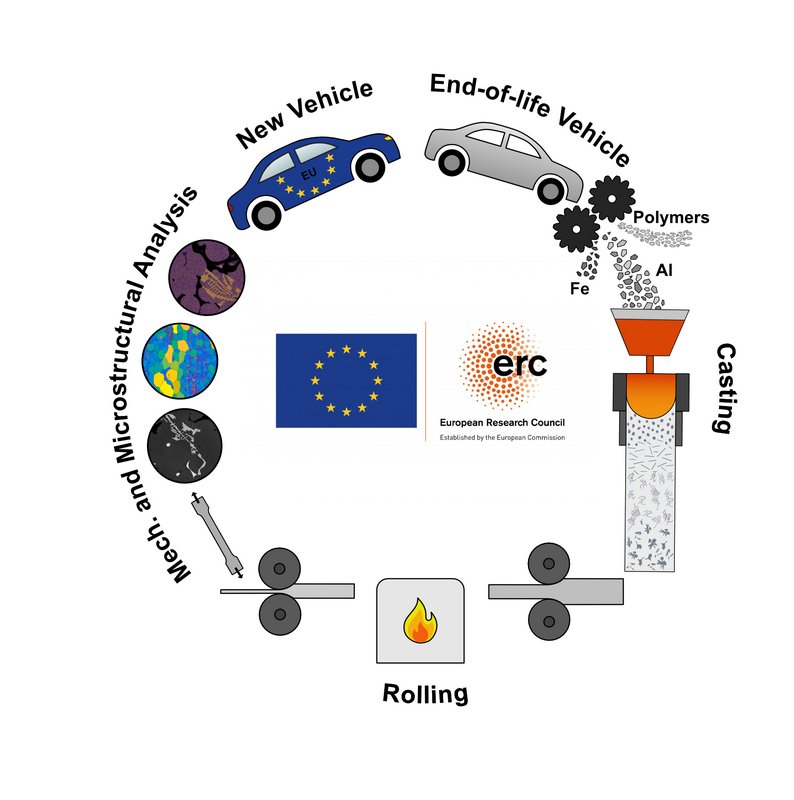
Recycling aluminium is of central importance, as producing secondary aluminium requires 90 to 95 % less energy than producing primary aluminium. However, metallurgy presents a significant challenge: impurities that enter aluminium during its life cycle can hardly be removed technically and not economically. This issue becomes particularly evident when recycling end-of-life vehicles, which may contain up to 40 different aluminium alloys as well as copper and steels. The complex material mix often results in high-purity aluminium alloys from vehicles being “downcycled” into lower-purity cast engine blocks.
Given that almost 100 million vehicles were produced in 2017, there is enormous potential for innovative recycling approaches. The ERC Consolidator Grant project HETEROCIRCAL – Intermetallic Phase Heterostructured Circular Aluminium Alloys (April 2024 to March 2029), led by Univ.-Prof. Dr.mont. Stefan Pogatscher from the Chair of Nonferrous Metallurgy, focuses on the recycling process of aluminium scrap. HETEROCIRCAL addresses how the decline in engine blocks, due to the growing prevalence of electric vehicles, will affect aluminium recycling, and aims to break the paradigm of harmful impurities in aluminium alloys. Instead, impurities are to be purposefully utilised to create advantageous structures in aluminium materials.
This includes the targeted manipulation of impurity-driven intermetallic phases during various processes such as solidification, heat treatment, or forming. These approaches aim to make a decisive contribution to establishing sustainable and efficient aluminium recycling that meets the increasing demands for resource conservation and climate protection.
Contact Person
Univ.-Prof. Dipl.-Ing. Dr.mont. Stefan Pogatscher - Chair of Nonferrous Metallurgy
E-Mail: stefan.pogatscher(at)unileoben.ac.at
Tel.: +43 3842 402 5228
SECMET-SURACT
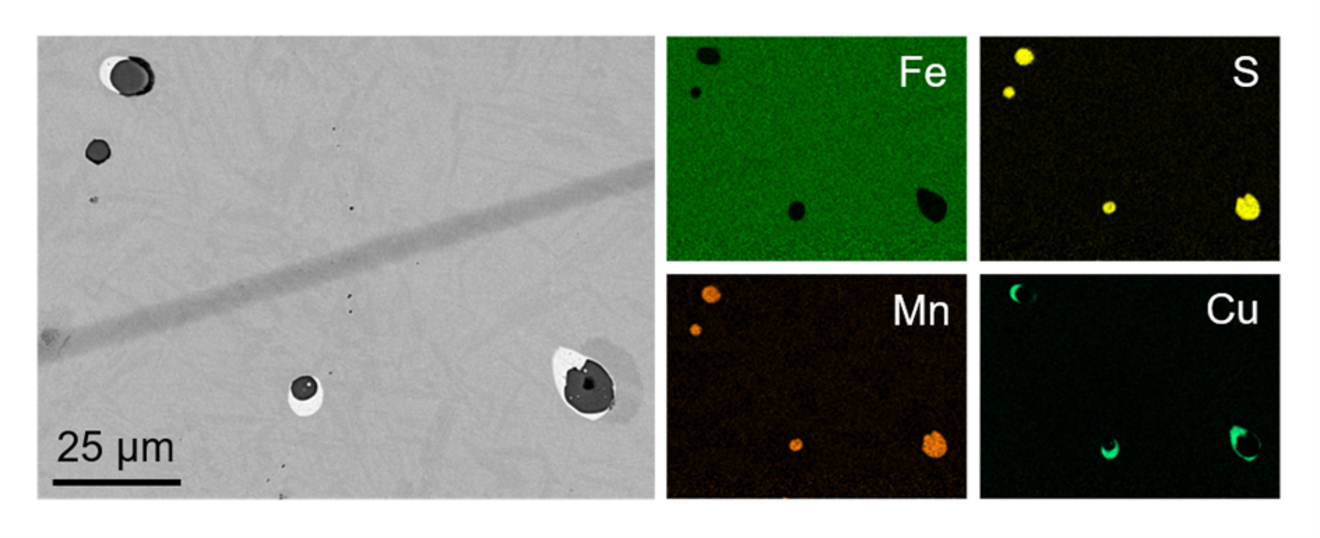
The SECMET-SURACT project, part of the Christian Doppler Laboratory for Inclusion Metallurgy in Modern Steelmaking, investigates interactions between surface-active elements and non-metallic inclusions. Through the recycling of lower-quality scrap, trace elements such as copper, tin, or molybdenum accumulate in steel melts. These elements reduce the surface tension of steels, thereby influencing interface-controlled processes such as the formation or precipitation of inclusions.
Many trace elements exhibit only low solubility in steel at room temperature. As a result, they tend to form precipitates at grain boundaries and around non-metallic inclusions, potentially altering local properties. Since non-metallic inclusions often serve as crack initiation sites - particularly in dynamically loaded components - the deformability of inclusions is relevant to component safety.
The project therefore focuses on interactions between trace elements and non-metallic inclusions. Experimental work includes wettability studies with liquid steel, as well as investigations of the mechanical properties of inclusions in solid steel using nanoindentation and deformation dilatometry.
Contact Person
Univ.-Prof. Dipl.-Ing. Dr.mont. Susanne Michelic - Chair of Ferrous Metallurgy
E-Mail: susanne.michelic(at)unileoben.ac.at
Tel.: +43 3842 402 2200
The Iron Ore Sintering Machine as a Central Recycling Unit in an Integrated Steel Plant

In an integrated iron and steel plant, the sinter belt is a key recycling unit for the internal recirculation of materials from by-product streams. Through the sintering machine, iron-containing plant residues such as mill scale or blast furnace dust can be recycled and reintegrated into the primary material flow. Limitations in material recirculation may arise from accompanying elements such as zinc or phosphorus, meaning that specific preparation strategies for certain residues must be considered prior to their reintroduction. Achieving a high recycling rate while maintaining good product output from the sinter strand conserves both energy and primary material resources and reduces the need for landfilling. During sintering, coke breeze—produced as a by-product in coke manufacturing—is used as an energy carrier, leading to corresponding CO₂ emissions. Although flue gas recirculation is state of the art for minimising emissions, targeted adjustment of the recycled gas composition can significantly reduce the coke breeze requirement and, consequently, the energy footprint. As the iron and steel industry accounts for around 7 % of global greenhouse gas emissions and production rates are still increasing, higher recycling rates are essential for reducing emissions. The sintering machine will therefore remain of decisive importance in the future. A new process variant is currently being developed, which, through appropriate conditioning steps, will allow significant proportions of valuable material from LD slag to be recycled via the sinter belt.
Contact Person
Ass.Prof. Dipl.-Ing. Dr.mont. Jan Eisbacher-Lubensky - Lehrstuhl für Eisen- und Stahlmetallurgie
E-Mail: jan.eisbacher-lubensky(at)unileoben.ac.at
Tel.: +43 3842 402 2239
Other involved chairs - Geology and Economic Geology, Process Technology and Environmental Protection
DRAES – Designing Recycled 6082 Alloy for Energy Saving

The aluminium alloy EN AW 6082 (AlSi1MgMn) is among the most widely used aluminium alloys in the automotive and construction industries due to its well-balanced combination of cost, mechanical properties, and formability. To ensure these properties, the fraction and the morphology of the microstructural constituents have to be well controlled during the production process from the ingot material to the finished product. This aim is closely related to the amount of alloy- and trace elements involved. It is evident that this task becomes more and more challenging as the share of secondary ingot materials (post-consumer scrap) rises. The project DRAES faces these challenges by combining classical, experimental alloy development with the means of machine learning (ML) methods. By establishing of a solid database, based on numerous lab experiments and literature sources, ML models which are capable of predicting the microstructure and the resulting mechanical properties from the chemical analysis of the ingot are developed. This is an important step towards the process-reliable manufacturing of high-quality components from recycled materials.
Contact Person
Univ.-Prof. Dipl.-Ing. Dr.mont. Peter Hofer-Hauser - Chair of Casting Research
E-Mail: peter.hofer-hauser(at)unileoben.ac.at
Tel.: +43 3842 402 3300