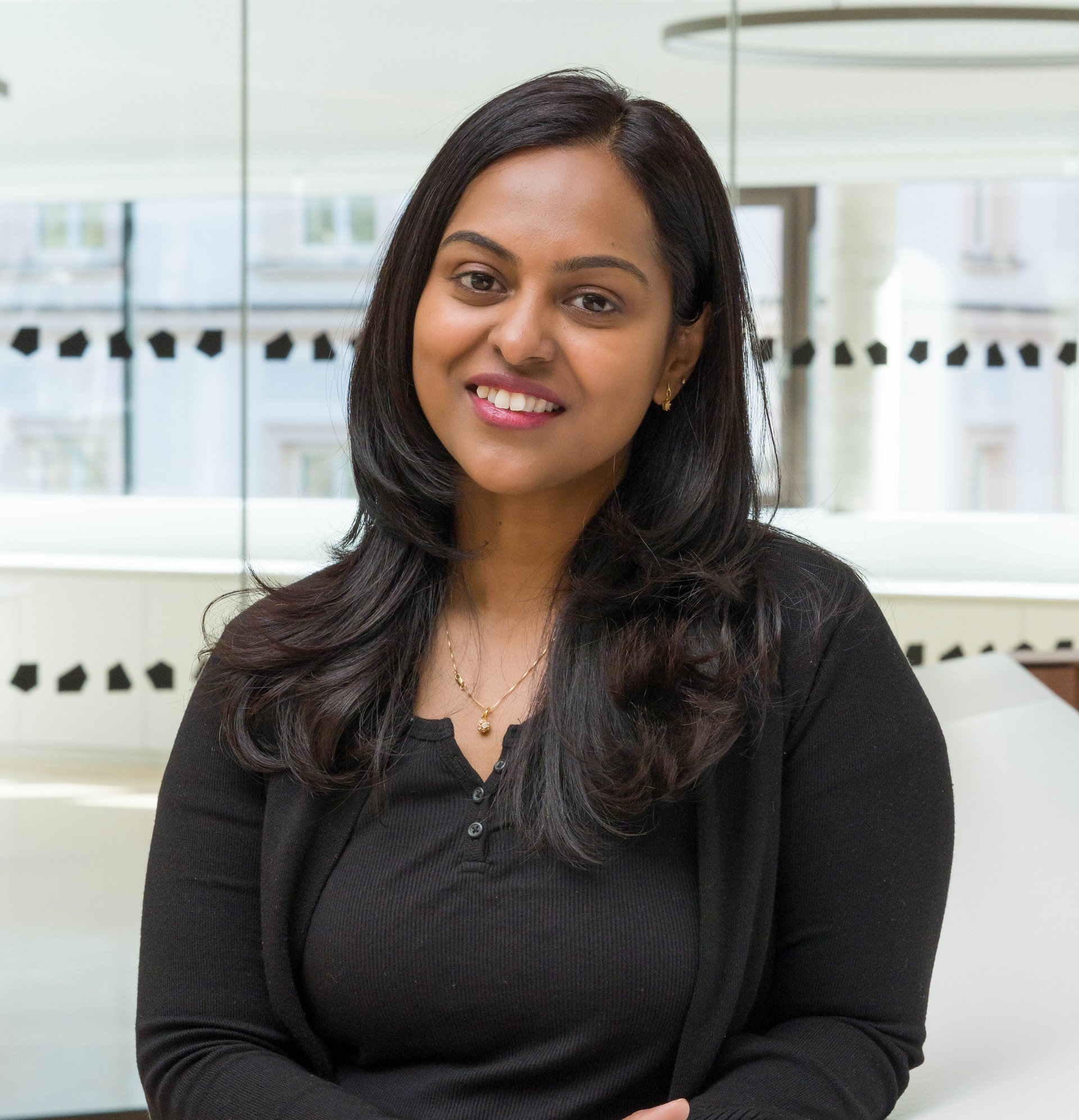
With her international experience, the researcher brings important new perspectives to Leoben. Following stations in India and Finland, she aims to further develop construction and materials research at TU Leoben and leverage the university's proven expertise in raw materials, mining, and materials engineering for innovative applications. Even prior to her move to Leoben, she collaborated with the Technical University of Leoben as part of the Horizon Europe project “Reesource”.
Industrial Residual Materials as Valuable Resources
At the center of her research is the question of how building materials can be produced more sustainably and how natural resources can be conserved. Building Materials such as wood, natural stone, and cement are essential components of our buildings and infrastructure. However, their extraction, production and use are associated with a high demand for natural resources. Concrete plays a particularly significant role here: after water, it is one of the most widely used materials in the world. Yet, its production requires large amounts of raw materials and energy. At the same time, numerous industrial sectors produce residual materials that are still frequently sent to landfills.
This is precisely where Professor Perumal's research comes in: “For me and the people of my research area, waste is not simply waste”, says the new head of the Chair of Ceramics. “What is residual for one industry can be a valuable resource for another application.” By-products from mining, the steel industry, and construction and demolition processes should not be landfilled, but instead used as raw materials for new, high-performance building materials. This makes it possible to reduce the demand for natural raw materials on the one hand and meaningfully utilize industrial material flows within circular systems on the other. Her research approach can therefore be summarized in a single sentence: “One person's waste is another's resource.”
Personal Background: From India via Finland to Leoben
Born in India, her academic career began with a bachelor's degree in civil engineering. After a brief professional detour into software development, she made a conscious decision to return to her original field. “I didn't want to sit at a computer and write programs, I wanted it more interactive – to see and feel what could emerge from my work,” says Perumal.
During her subsequent research-focused master's degree in Structural and Geotechnical Engineering, she worked with a mining company for the first time. The focus was on how residual materials from mining could be made usable for construction applications. For her doctorate at the Indian Institute of Technology Madras in Chennai, she deepened these research questions and studied sustainable building materials. She also worked on treating methods to process overburden and soil materials from open-cast mining for use in the construction sector.
Subsequently, her academic career took her to Finland. There, as a postdoctoral researcher in a one-year research project, she initially focused on developing high-strength building materials using alkaline activation with slag from the steel industry. This was followed by a Marie Skłodowska-Curie (MSCA) Postdoctoral Fellowship, one of the European Union's most prestigious research funding programs. At the University of Oulu in Finland, as an Associate Professor, she built up her own research group consisting of doctoral candidates and postdocs, focusing primarily on sustainable building materials and their application. She remains connected to the University of Oulu as an Affiliate Professor.
New Perspectives for the Building Materials Sector Through Circular Engineering
Priyadharshini Perumal finds ideal conditions for her research at TU Leoben, especially with the university’s expertise in raw materials, mining, and materials engineering. She’s looking forward to establishing new research structures and expanding research on innovative and more sustainable building materials at the chair of Ceramics. For the new head, this offers the opportunity to help shape forward-looking research priorities right from the start. In doing so, she relies on Circular Engineering: materials should be kept in the loop for as long as possible, residual materials understood as resources, and new building materials developed in a way that meets both ecological and technical requirements.
Furthermore, a key personal goal is to inspire young women to pursue research and in particular civil engineering. “I come from a very conservative area in India where there were not many female professionals, certainly not in engineering, and even less so in civil engineering.”
For her work at the Chair, the new head relies on collaboration, openness, and a flat team structure. “I don't see myself as a manager, but as part of the team.” Her aim is to roll up her sleeves alongside her staff, share knowledge, and continuously learn herself. Even outside of research, Leoben quickly won over the new professor. During her first visit, she was particularly impressed by the mountain landscape on the train ride from Vienna to Leoben. She also appreciates the manageable size of the city and the strong sense of community at Technical University of Leoben.
With her international experience and focus on sustainable building materials, she aims to actively shape the further development of research in this field at TU Leoben.
Contact:
Univ. Prof. Priyadharshini Perumal
Institute of Building Materials and Refractory Technology
Montanuniversität Leoben / Technical University of Leoben
Tel.: +43 3842 402 3200
E-Mail: priyadharshini.perumal(at)unileoben.ac.at