
Interesting self-study courses on accessible teaching
10. Juni 2026 12:30 - 13:30
Accessible teaching involves more than just technically accessible materials; it begins with the pedagogical design itself. In this session, we will outline the benefits that accessible materials offer to all learners and discuss specific measures we can take to promote participation, inclusion and learning success.
The focus is on typical barriers in digital teaching resources, legal frameworks, technical standards (e.g. WCAG) and, above all, specific strategies and tools for accessible teaching design that promotes diversity and breaks down barriers.
ADHD and College Studies. Online event on May 20, 2026
Wednesday, May 20, 2026, 10:00 a.m. to 11:30 a.m., online event on Zoom
Online lecture by Mag. Anna M. Binder-Kita, psychotherapist specializing in the therapeutic support of people with neurodivergent profiles, particularly those with ADHD and on the autism spectrum, inviseda.at
Moderator: Mag.a Lilian Levai-Dalbauer, Office for Equal Treatment Issues at Campus Wien University of Applied Sciences
Content
ADHD/ADD are common but often misunderstood topics in the higher education context. Many myths still circulate, making it difficult to perceive the symptoms in a nuanced way.
The lecture provides an overview of the key characteristics of ADHD in adulthood, highlights common misconceptions, and explains the difference between ADHD/ADD and autism spectrum disorders (as well as possible dual diagnoses).
In addition to this fact-check, the lecture addresses practical questions:
- How does ADHD manifest itself in students’ daily academic lives?
- Which comorbidities occur particularly frequently?
- And what strategies and approaches help faculty and staff effectively support students?
The goal is to combine well-founded knowledge with concrete actionable insights that can be directly applied in everyday university life.
Digital Technologies and Accessibility in Higher Education: Inclusive, Accessible, and Equitable
Digital Accessibility in Practice – Moving Beyond Black-and-White Thinking
In this fnma Talk, Gottfried Zimmermann explores the challenges and potential of digital accessibility from various perspectives.
Digital Accessibility | iMooX.at
This is a video from the course ‘Navigating University Life: Diversity-Sensitive, Aware of Prejudices and Inclusive’ at imoox.at/course/antibias
This free MOOC highlights the variety of experiences in everyday (university) life and the diversity of people within the university community. It offers suggestions for developing a more sensitive awareness and for reflecting on one’s own position within existing power structures.
The nine lessons of the MOOC highlight potential challenges in everyday university life relating to gender, race, class, disability, religion, etc. It provides explanations of everything that happens in university life, as well as suggestions for action to foster an inclusive environment with minimal bias and discrimination. The course consists of 9 lessons. The time required for the course is estimated at 2 hours per lesson. You can find the full course playlist here:
Navigating everyday university life: diversity... iMooX is the first and only Austrian MOOC platform. On iMooX, we offer free online courses (Massive Open Online Courses) on a wide range of topics. The courses are openly licensed and can be taken anytime, anywhere. The platform’s existing range is constantly being expanded with exciting new courses.
diversitätssensibel, vor(ur)teilsbewusst und inklusiv
Welcome to the AntiBias MOOC!
We’re glad you’re here to
- learn what lies behind the frequently used term “diversity,”
- expand your understanding of numerous common terms,
- recognize power dynamics and discrimination through examples and become more aware of them in everyday life,
- discover connections between power dynamics,
- sharpen your awareness of biases and prejudices,
- recognize to what extent and when you yourself are privileged or disadvantaged,
- and act in a more diversity-sensitive and supportive manner in your daily (university) life.
Collection-Padlet for teachers
Here you will find an extensive collection of resources on the topic of accessible teaching materials.
How to make a course more accessible?

Here you will find a short summary, further links and helpful tips for your teaching.
Accessibility in Moodle
Introduction to Accessibility in Moodle
This course includes the presentation from the brief introduction to accessibility in Moodle, which was given as part of the kick-off for the Brickfield testing phase on the Moodle.NRW Knowledge Base on June 4, 2024.
The information provides an introduction to the topic but is not a comprehensive guide.
License: Moodle.NRW (2025), “Introduction to Accessibility in Moodle,” CC BY-SA 4.0
Self-study course from Bielefeld University
Introduction
Digital and online exams have become an integral part of higher education. They offer many advantages, including flexibility, efficiency, and new pedagogical possibilities. However, for students with disabilities or chronic health conditions, digital exams can present significant challenges. Accessibility is therefore an essential aspect of ensuring equal opportunity and enabling all students to participate fairly in exams.
This self-paced course provides foundational knowledge about accessible digital exams in higher education. You will learn about existing legal requirements, the technical and pedagogical measures that promote accessibility, and how to design exams so that all students can participate on an equal footing.
Since digital exam formats—and the Moodle learning platform in particular—are constantly evolving, this course cannot provide fixed, step-by-step instructions. The technical framework, functions, and terminology change regularly, so specific instructions would quickly become outdated.
Instead, the course includes questions and information on accessibility and e-exams that help participants understand the principles of accessible e-exams and apply them to the current technical environment. This provides instructors, exam administrators, and university staff with guidance to develop their own solutions tailored to specific situations. An accompanying guide also compiles key information.
- Accessibility: Fundamentals and Legal Framework
- Digital and Online Exams
- Implementing Accessible Online Exams
https://openmoodle.uni-bielefeld.de/course/view.php?id=112#section-1
Lizenz CC BY 4.0: Kim Althoff, Michael Johannfunke, Dustin Matzel (Zentrale Anlaufstelle Barrierefrei (ZAB)) und Hakan Cetin (PH Freiburg). Projekt SHUFFLE, Universität Bielefeld. Die Lizenz erstreckt sich nicht auf Inhalte Dritter. Anders lizenzierte Inhalte sind entsprechend gekennzeichnet.
Accessibility Toolkit for Moodle
Click in your Moodlecourse MORE/Tools Accessibility/submit for analysis.
GESTU Graz
Service centre for students with hearing impairments

Guide for teaching GUIDE
SUCCESSFUL STUDYING FOR DEAF AND HARD-OF-HEARING STUDENTS

Word Accessibility Check
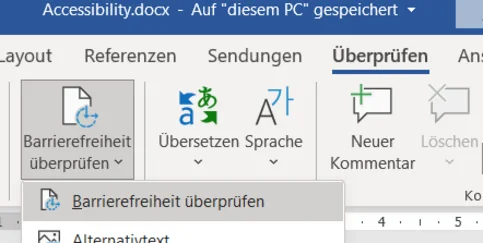
Screenshot in microsoftWord/check/accessibility © MUL