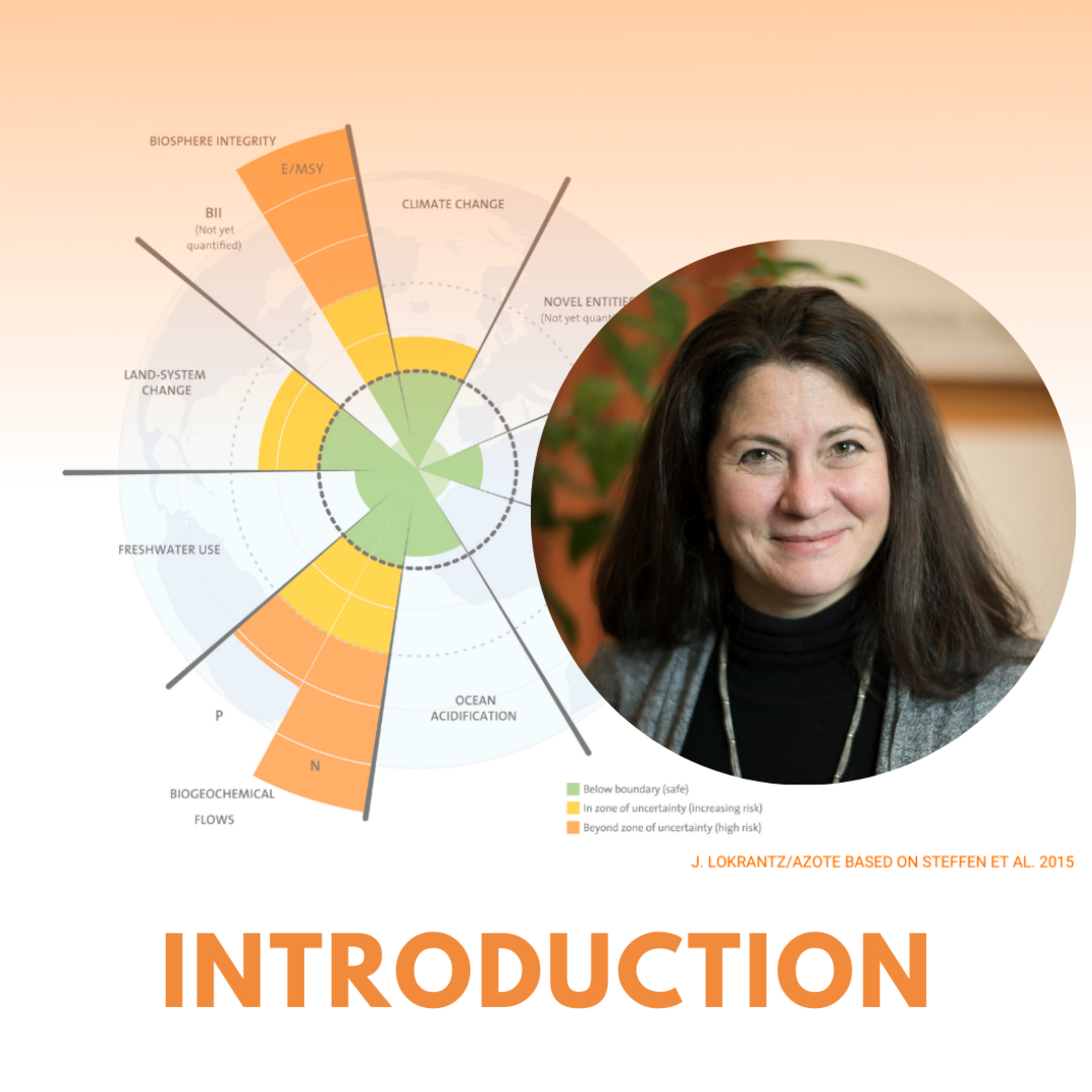
On 12 October 2021, the online lecture series dedicated to the topic “Planetary Boundaries” was kicked off by the introductory lecture of Sarah Cornell, Associate Professor in sustainability science at Stockholm University.
Sarah Cornell works as a Principal Researcher in the Stockholm Resilience Centre, an internationally influential research centre that seeks to advance the scientific understanding of the complex, dynamic interactions of people and nature in the biosphere. Her research background is originally in global biogeochemistry, extending over the years to also address the study of human dimensions of global environmental change.
Sarah Cornell is part of the researchers’ group of international interdisciplinary scientists, who have developed the Planetary Boundaries framework in 2009 and continuously work on improving it.
Laying the framework for the lecture, Professor Cornell explains that she sees the world as earth system, as interaction between land, ocean, atmosphere and life and how human life perturbates this system. As she points out, planetary boundaries describe different features of earth system change as it departs from these relatively stable conditions.
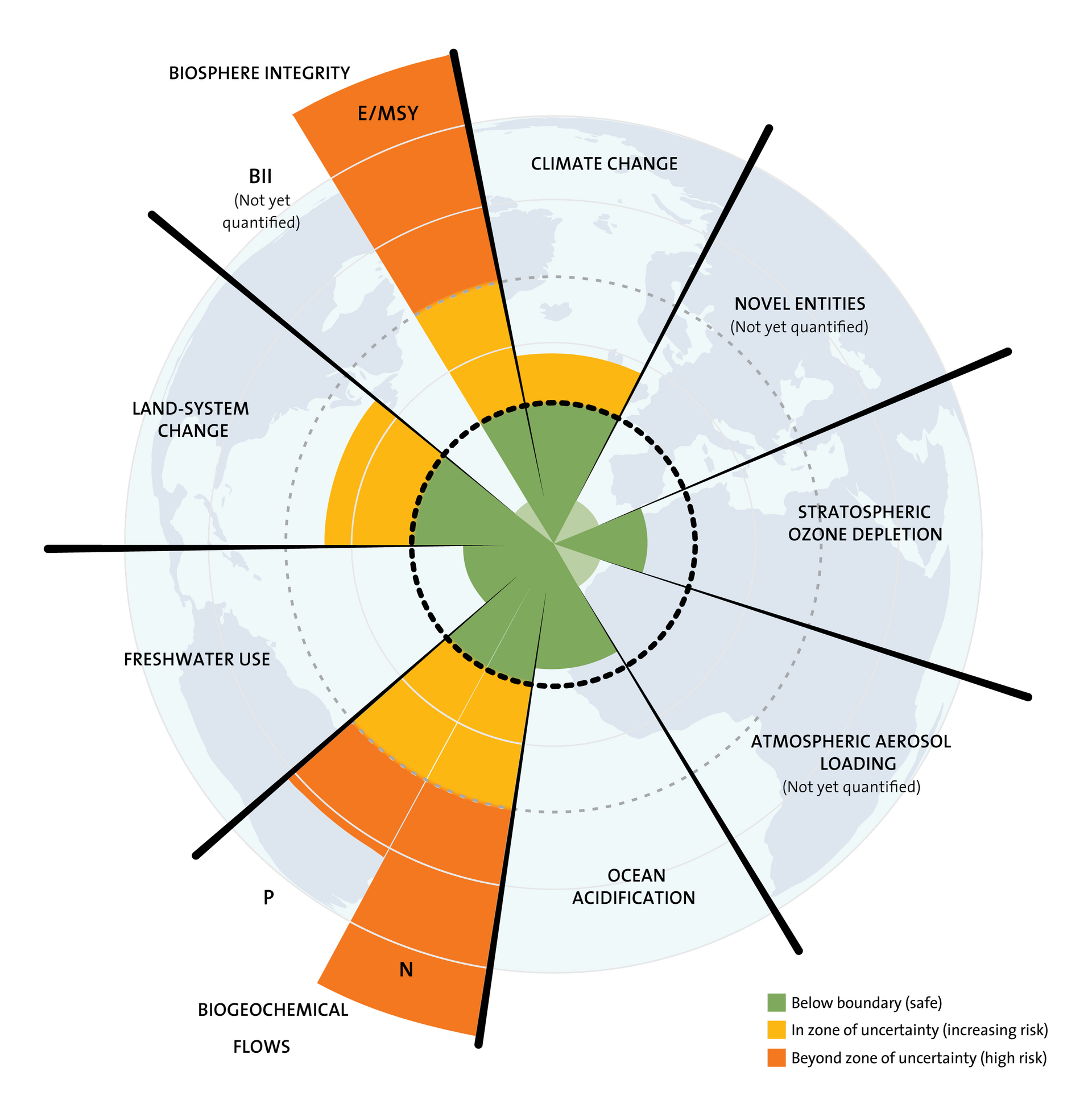
The planetary boundaries framework identifies nine processes of the earth system, which are interlinked. The nine planetary boundaries are:
- climate change
- change in biosphere integrity
- land-system change
- freshwater use
- biochemical flows
- ocean acidification
- atmospheric aerosol loading
- stratospheric ozone depletion
- novel entities
The Resilience Centre, where Professor Cornell works, sees the world in terms of interconnected systems, taking a look at processes of change but also processes of resilience - ways in which to deal with these changes. Explaining the lecture’s starting point, Professor Cornell says that it is already a known fact, that people are changing the environment intentionally, but sometimes these changes have unwanted consequences. The more humans change the climate, the more unpredictable it becomes. Similarly, we reduce the biodiversity or, as Professor Cornell calls it, ‘the livingness’ of the planet. According to the planetary boundaries framework, within these boundaries, humanity can operate safely. While crossing them leads into the zone of uncertainty and increased risk, transgressing them further will lead beyond the zone of uncertainty into the zone of high risk. Transgressing one or more planetary boundaries may trigger irreversible and unstoppable environmental changes.
The related social message transmitted by Sarah Cornell is, the more we undermine the living processes of the earth, the less resilient the planet becomes to the changes we impose upon it. Her inspiring lecture gave an overview over the background of the framework as well as an outlook, what its message means for today’s and tomorrow’s life.
The illustrations are free to use in publications, scientific or otherwise, describing the planetary boundaries concept. Correct credit is required.
Download 2015 Planetary Boundaries illustration (credit: J. Lokrantz/Azote based on Steffen et al. 2015)