Authors: Charlotte E. Green, James U. L. Baldini, Richard J. Brown, Hans-Ulrich Schmincke, Marie Edmonds, Thomas C. Meisel
Abstract
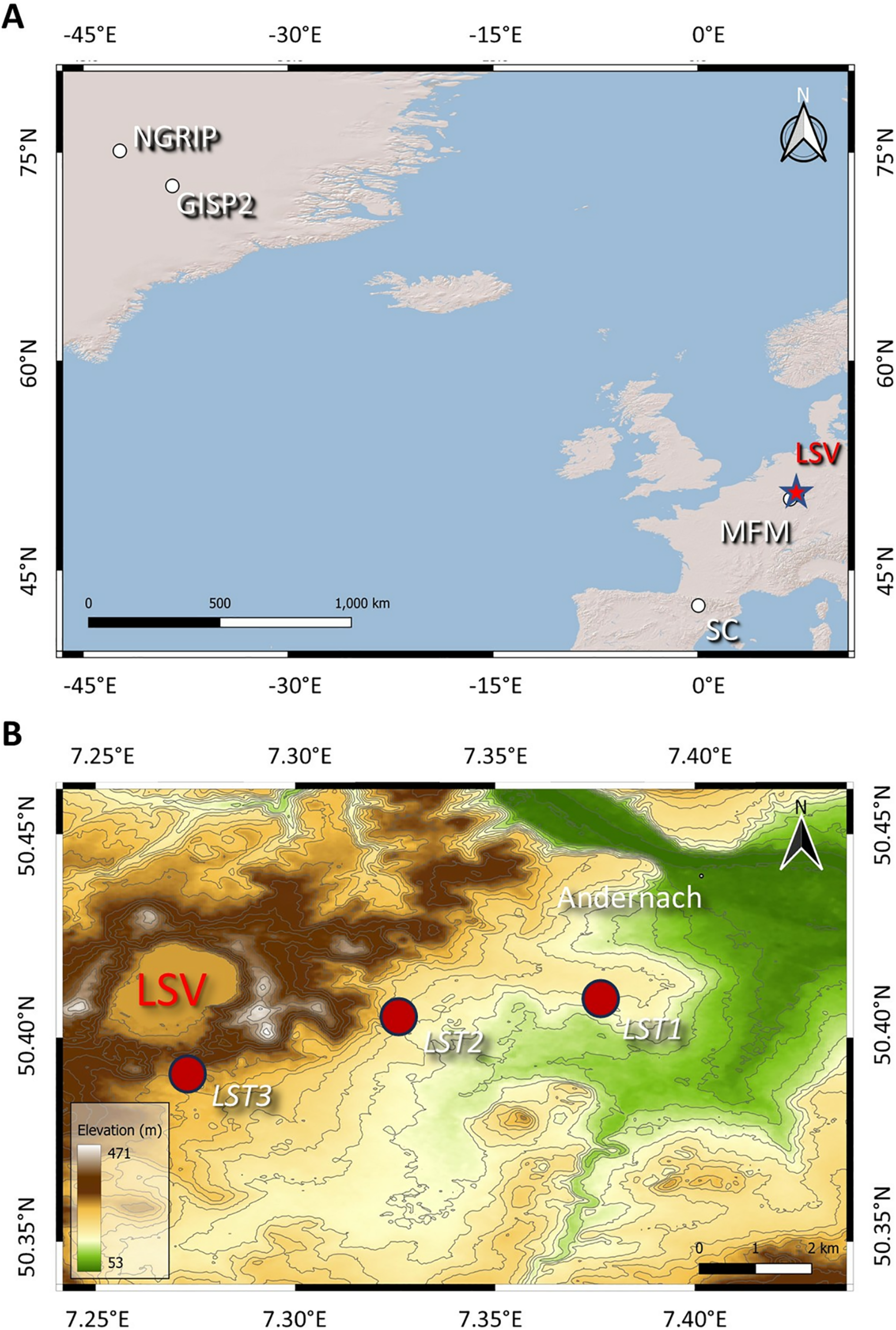
The Younger Dryas Event (YDE) is the most recent and most well-understood millennial-scale cooling event. A deglacial meltwater pulse is the traditionally accepted trigger for the event, but both a bolide impact and volcanism are recently advanced alternative explanations. A high Pt/Ir and Pt/Al geochemical anomaly within the Greenland Ice Sheet Project (GISP2) ice core, broadly coinciding with the YDE initiation, provides a possible geochemical clue to the events leading up to the YDE. Previous research has suggested that the impact of an unknown type of high Pt/low Ir iron meteorite may have produced this Pt spike, but the timing is also very close to a large sulphur spike within the North Greenland Ice Core Project (NGRIP) ice core and the timing of the Laacher See volcano eruption (which occurred at approximately 13 ka), suggesting a possible volcanic origin. Here, we evaluate both suggestions by i) presenting new geochemical data from the Laacher See Tephra (LST) and ii) confirming the Pt spike timing relative to the YDE onset on the GICC05 timescale. Our geochemical results, and specifically iridium and platinum data, strongly suggest that the Laacher See eruption (LSE) was most likely not the source of the Greenland Pt spike. Additionally, we corroborate recent work showing a chronological offset of several decades between the Pt spike and the North Greenland Ice Core Project (NGRIP) sulphur spike, the initiation of the YDE at 12,870 ± 30 yr BP (years before present, where present is defined as 1950 CE), and the nearest published age estimate for the LSE (12,880 ± 40 yr BP – though we note that more recent age determinations potentially push this date back by ~130 years). Based on modern data showing that Pt spikes in ice cores and sediment can arise from volcanic eruptions, we suggest that the GISP2 Pt anomaly may represent fractionated volcanic material from another, unknown volcanic eruption. Volcanic gas condensates from submarine volcanic complexes, and in particular Niuatahi-Motutahi (Tonga rear arc), have a Platinum Group Element (PGE) geochemistry most resembling the Pt spike, and we therefore suggest that the Pt spike represents highly fractionated material from an Icelandic subglacial or submarine fissure eruption. The 14-year-long duration of the Pt spike is also more consistent with a fissure eruption than an instantaneous event.