

Photo: © TU Leoben | Martina Stöbbauer

Photo: © TU Leoben | Martina Stöbbauer

Photo: © TU Leoben | Martina Stöbbauer

Photo: © TU Leoben | Martina Stöbbauer

Photo: © TU Leoben | Martina Stöbbauer

Photo: © TU Leoben | Martina Stöbbauer

Photo: © TU Leoben | Martina Stöbbauer

Photo: © TU Leoben | Martina Stöbbauer

Photo: © TU Leoben | Martina Stöbbauer
In order to prepare you as a first-year student for the start of your studies in the best possible way, the event "MINT @ Leoben" in the fields of mathematics, computer science, natural sciences and technology takes place in the summer before the official start of the semester.
| Next date: September 2027 |
The event is held in hybrid form, so that you have the opportunity to follow it from the comfort of your own home, as well as to gain initial experience on site in Leoben.
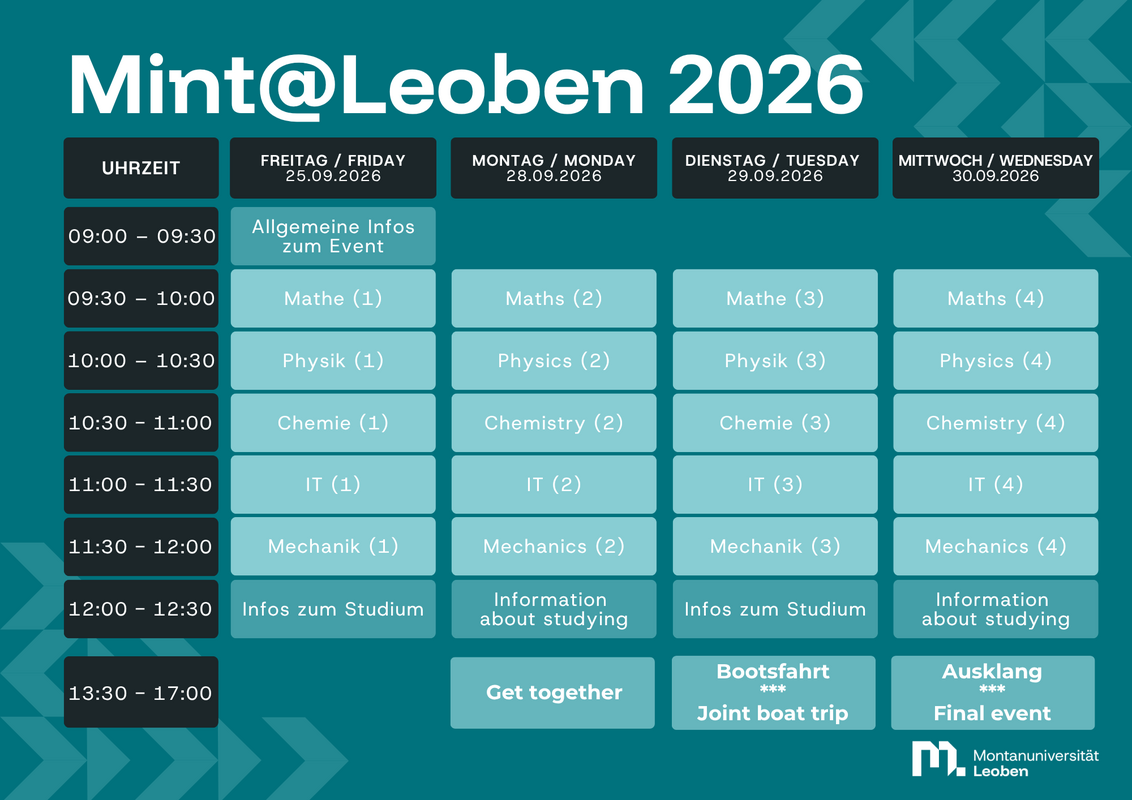
Timetable for the previous STEM Week 2026
Four days full of STEM discoveries before your studies in Leoben.
STEM subjects (MINT)
Our students, our so-called STEM influencers, will give you an insight into the following STEM subjects:
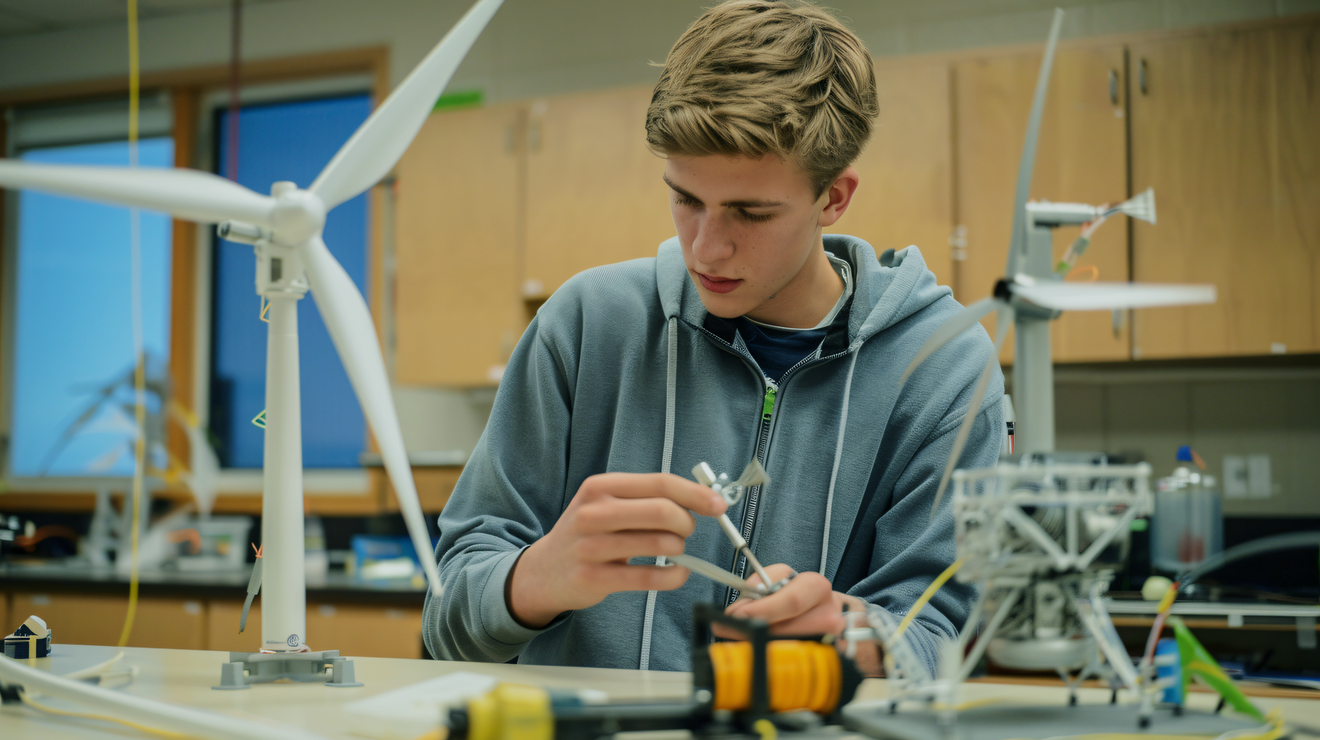
Mechanics
Hard to believe!
A scale does not measure kilograms! No kidding! But what does it measure then?
It measures weight force in newtons, that is the gravitational force with which the Earth pulls on us. It then converts the result into kilograms, taking the standard acceleration due to gravity into account. On the Moon an ordinary scale would therefore show far fewer kilograms, even though your mass remains the same.
Information technology

Art = Artificial?
In this case the analogy holds.
In the project “The Next Rembrandt” the master never held the brush himself. The image was created and printed with the help of artificial intelligence. Experts had previously trained the systems with countless of Rembrandt’s brushstrokes. This produced something like an artistic DNA. According to art historians only one important feature is missing, the gleam on the tip of the nose.
And this is only the beginning. What AI can already do today and why you need computer science knowledge for it you can experience live in our computer science sessions.
Physics
Struck by lightning
The first particle accelerators, which you might know from the film "The Da Vinci Code", appeared as early as 1925. Before that researchers relied on natural radioactivity, cosmic radiation and even high voltage drawn from thunderclouds. It was risky and hard to control. Accelerators quickly took over because they provide reproducible and safe high voltages.
In our physics sessions our students will show you more experiments and explain why physical processes are so important for your degree.
Mathematics
1, 2 or 3?
A quizmaster, three doors, two goats, the grand prize and you. You have reached the final round of a quiz show and can now choose one of the three doors. Behind one door is the main prize and behind the other two are two goats. You choose door 1, the quizmaster opens door 3 and there is a goat. He then asks you if you want to stay with door 1 or switch to door 2. How do you decide?
The "goat problem" is a famous dilemma in probability theory that many mathematicians have racked their brains over in the past. Assuming that the quizmaster always opens a door with a goat - and that this happens completely independently of your choice - you should switch in the sense of mathematics. In this case, the initial 1/3 chance of winning increases to 2/3. However, if you don't know the quizmaster's intentions, you should always trust your knowledge of human nature in such an offer....
Learn more about such dilemmas and how such considerations can help you in your studies in the Maths units from our students!
Chemistry

What do we have in common with pencils?
We are made of the same chemical material, carbon.
This substance is the second most abundant molecule in our bodies and almost 10,000 pencils could be made with it.
And that's not all: both graphite and diamonds are made of carbon. While graphite is very soft, diamond is the hardest material in the world. How does that work? The arrangement of the carbon atoms determines the hardness. But a diamond could still be made from pure graphite, namely under approx. 60,000 bar pressure and at a temperature of about 1,500°C.
As you can see, chemistry is not only important for school, but is also very useful in everyday life. Our students will tell you more about it live in the chemistry units!
Questions about university?
Find answers in our FAQs or start the contact assistant.