Authors: Stefan Wagner, Jakob Santner, Markus Puschenreiter, Johanna Irrgeher, Thomas Prohaska
Abstract:
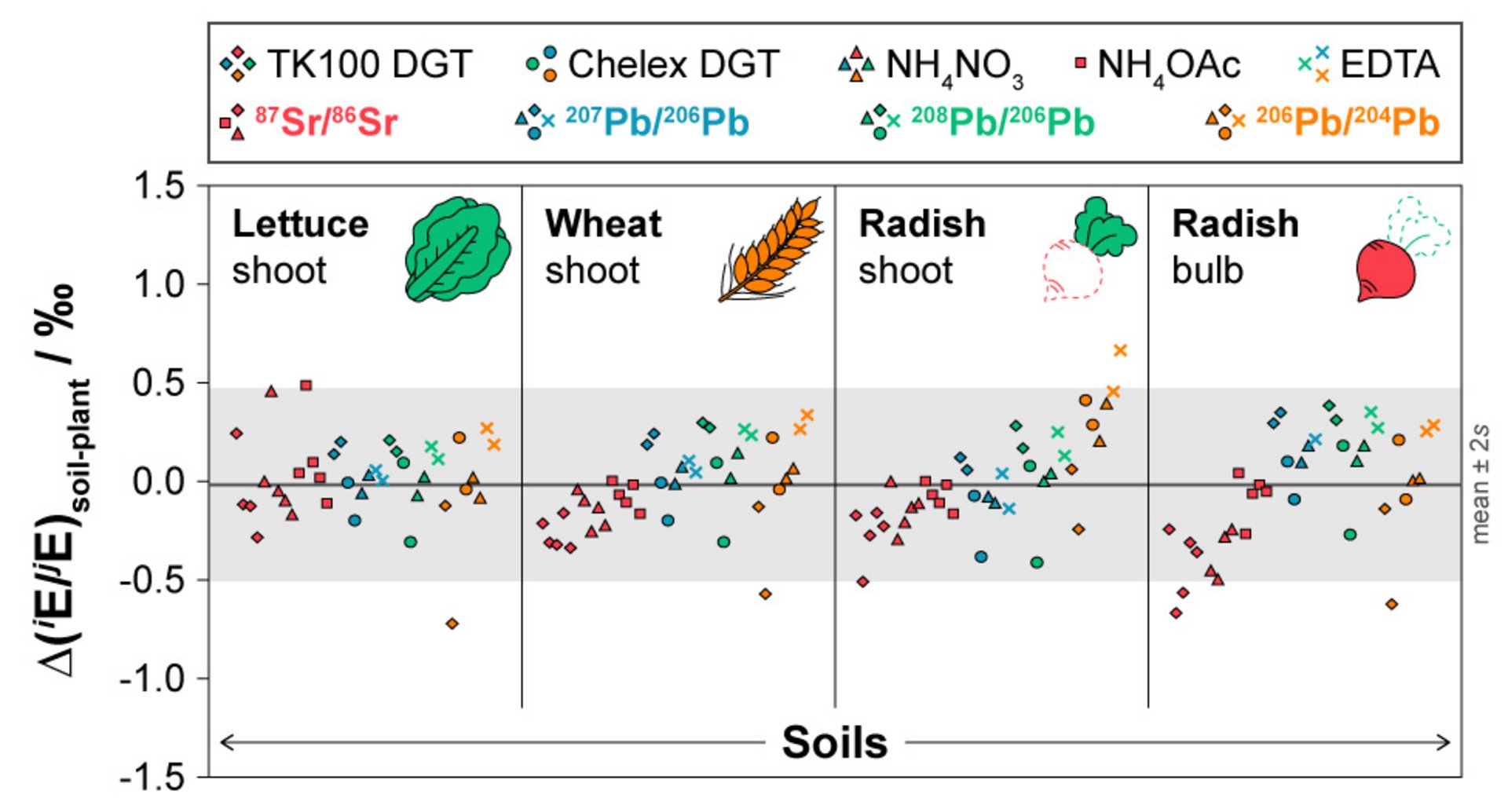
This study evaluated the potential of the diffusive gradients in thin films (DGT) technique to assess radiogenic strontium (Sr) and lead (Pb) isotope signatures in bioavailable soil fractions as a proxy for plant uptake. Concentrations (cDGT) and isotope ratios of Sr (87Sr/86Sr) and Pb (207Pb/206Pb, 208Pb/206Pb, 206Pb/204Pb) assessed by DGT (TK100, Chelex), along with extractable (NH4NO3, NH4OAc, EDTA) and total Sr and Pb mass fractions and isotope ratios, were compared to those in Lactuca sativa L. (lettuce), Triticum aestivum L. (wheat), and Raphanus sativus L. (radish) grown on five geochemically distinct soils. Relative to conventional soil extraction, DGT significantly reduced matrix loads, facilitating isotope ratio measurements by multi-collector inductively coupled plasma mass spectrometry. DGT-labile Sr and Pb concentrations and isotope ratios reflected soil-specific geochemical signatures, allowing for clear differentiation among soils. Importantly, DGT-labile isotope ratios closely matched those in plant tissues across soils and species within analytical uncertainty, demonstrating that DGT captures the isotopically relevant bioavailable Sr and Pb pool without inducing significant mass-dependent isotopic fractionation. These findings establish DGT as a practical tool for bioavailable multi-isotope tracing with strong potential for applications in environmental forensics, food authentication, and archaeological provenance research.
https://link.springer.com/article/10.1007/s00216-026-06315-6