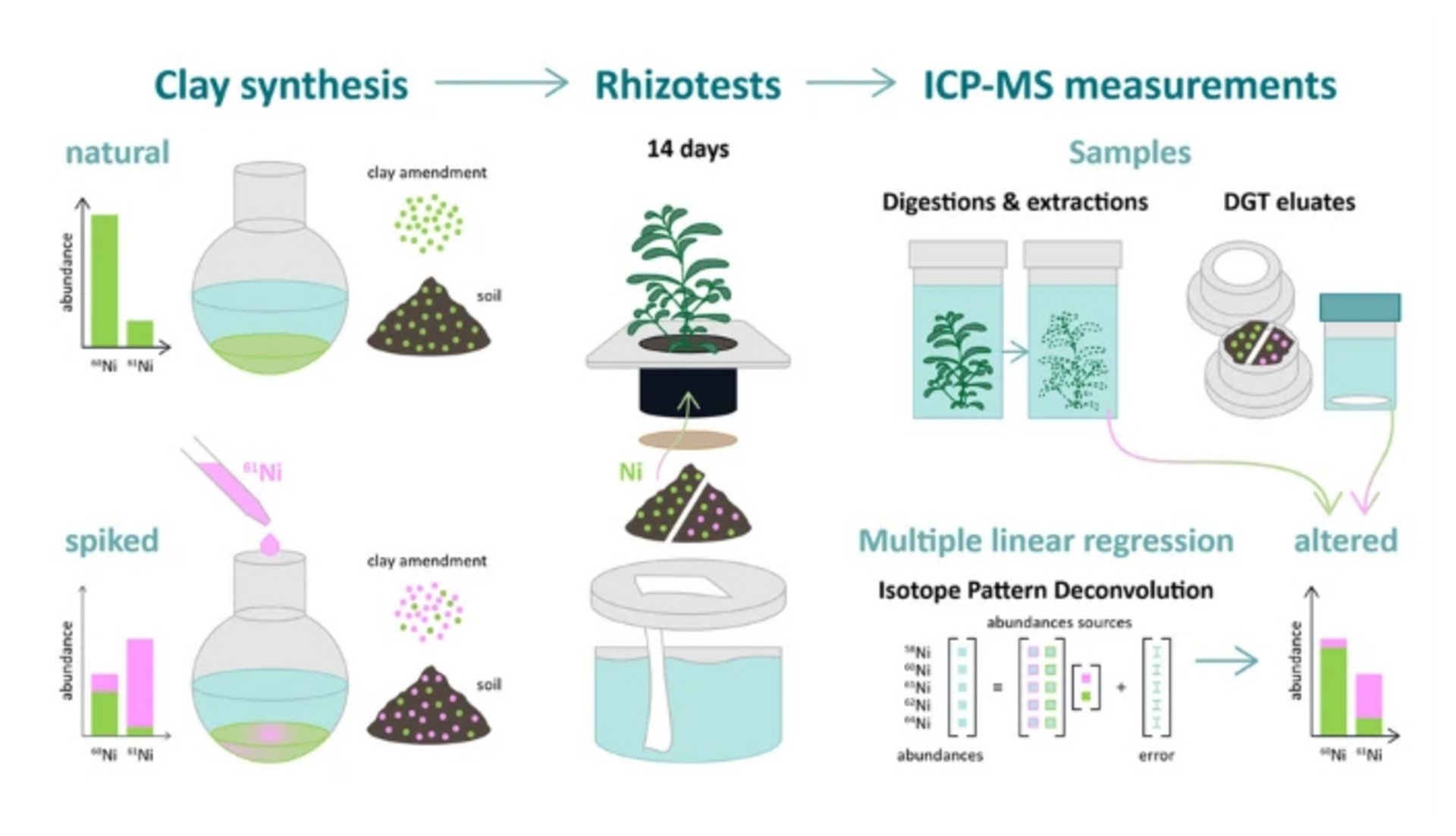
Title: Tracking nickel uptake pathways in hyperaccumulator plants using a 61Ni-enriched stable isotope tracer in soil
Authors: Simone Trimmel, Alexander V. Epov, Nadine Abu Zahra, Tobias Berger, Thomas Prohaska, Markus Puschenreiter, Antonia Siebenbrunner, Alice Tognacchini, Stefan Wagner, Johanna Irrgeher
Abstract: Understanding the mechanisms of nickel (Ni) uptake by hyperaccumulator plants is essential for advancing sustainable phytomanagement. In this study, saponite materials containing either isotopically natural or 61Ni-enriched Ni were synthesised and applied in RHIZOtest experiments with Odontarrhena chalcidica. The amendments were mixed with two ultramafic soils differing in Ni content, alongside a serpentinite control. Ni bioavailability and uptake were evaluated via elemental and isotopic analysis of plant digests and diffusive gradients in thin films (DGT). Stable isotope spiking with 61Ni allowed tracing of amendment-derived Ni uptake into plant tissues, even though total Ni mass fractions in planted versus unplanted soils did not indicate significant mobilisation during the 14-day growth period. Isotope pattern deconvolution (IPD) revealed clear shifts in Ni isotopic composition in both plant and DGT samples. Tracer uptake was more pronounced in the low Ni soil, with amendment-derived Ni (xamendment) contributing 19.3 ± 5.0% of total Ni in shoots, compared to 7.7 ± 1.8% in the high-Ni soil. In standard solutions containing 50 ng g−1 total Ni, isotope pattern shifts were still detectable at enrichment levels as low as 0.01% xspike (≈ 5 pg g−161Ni). The findings demonstrate the sensitivity of stable isotope spiking combined with IPD in the detection of subtle uptake processes, even in short-term experiments. This approach enables the differentiation of various Ni sources in soil–plant systems that would not be achievable with quantification alone, and can thereby provide new insights into how soil mineralogy influences uptake dynamics in metal-hyperaccumulating species.
Title: Lateral resolution of DGT LA-ICP-MS for chemical imaging of metal solutes
Authors: Gulnaz Mukhametzianova, Stefan Wagner, Thomas Prohaska
Abstract: Diffusive gradients in thin films (DGT) coupled with laser ablation inductively coupled plasma mass spectrometry (LA-ICP-MS) is increasingly applied for high-resolution chemical imaging of metal solutes, yet its effective lateral resolution has not been quantitatively assessed. This study provides the first targeted investigation of the lateral resolution achievable with state-of-the-art DGT LA-ICP-MS using copper (Cu) as a model analyte in three complementary experimental designs that isolate diffusion-controlled, geometry-controlled, and material-controlled constraints: (i) Controlled solute transport through a polytetrafluoroethylene (PTFE) foil with 5–100 µm holes revealed differential time-dependent broadening of solute and matrix patterns and the transition from geometry-preserving to diffusion-dominated behaviour. Full width at half maximum/minimum (FWHM)-based analysis showed very small apparent lateral “imaging-blur” coefficients for DGT-bound metals (Cu/Zn ≈10−15–10−13 m2 s−1), i.e., several orders of magnitude lower than typical ionic diffusion in hydrogels (≈10−10 m2 s−1), consistent with rapid immobilization at the DGT binding phases and modest lateral within-gel diffusion. (ii) Direct gel contact with Cu metal grids enabled quantitative comparison of nominal bar/hole dimensions with DGT-derived solute patterns, demonstrating that features down to ~25 µm are detectable under optimal contact and laser ablation conditions. (iii) Application to printed circuit boards confirmed the method’s ability to reproduce sub-mm Cu features on technologically relevant materials. Across experiments, gel-phase lateral diffusion and imperfect gel-sample contact were the dominant factors limiting spatial accuracy. These results define the practical lateral resolution of DGT LA-ICP-MS and provide guidance for designing and interpreting high-resolution solute imaging experiments in environmental and materials science.
Lateral resolution of DGT LA-ICP-MS for chemical imaging of metal solutes